
 Nobuaki Sato





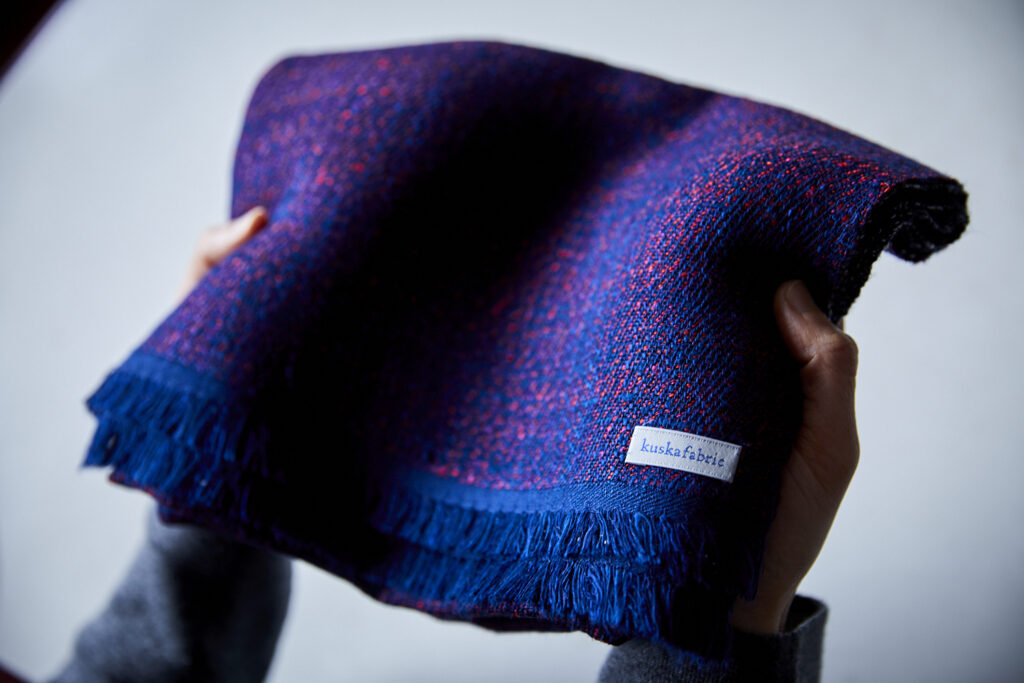
When Yasuhiko Kusunoki took over his family’s silk-weaving business in Tango, Kyoto — one that was on the verge of shutting down — he gave up every power loom and kept only the hand loom. It is the slowest way to weave cloth: even a master weaver can produce enough silk for only two or three ties a day. Local artisans dye the thread using dyes made for kimono, and every tie is sewn by hand at a long-established workshop in Uji, south of Kyoto.
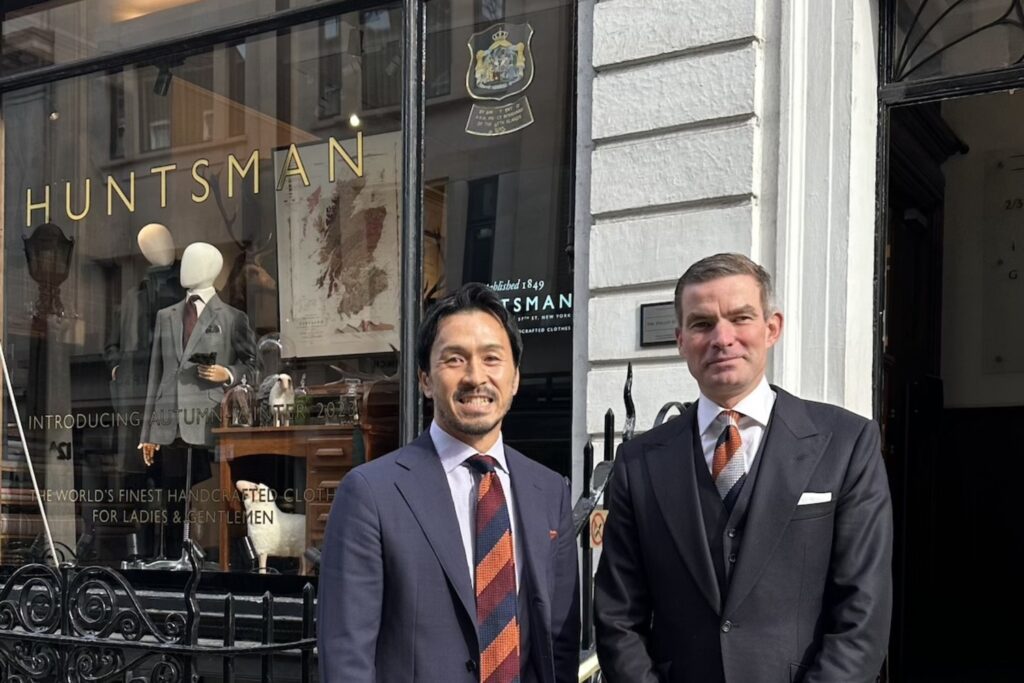
Today, that hand-woven silk can be found at a historic tailor on London’s Savile Row.
We spoke with Kusunoki, who heads kuska fabric, about the journey from a surf trip home to Tango, on the Sea of Japan coast, to making cloth that now crosses oceans.
From Kimono Silk to Ties
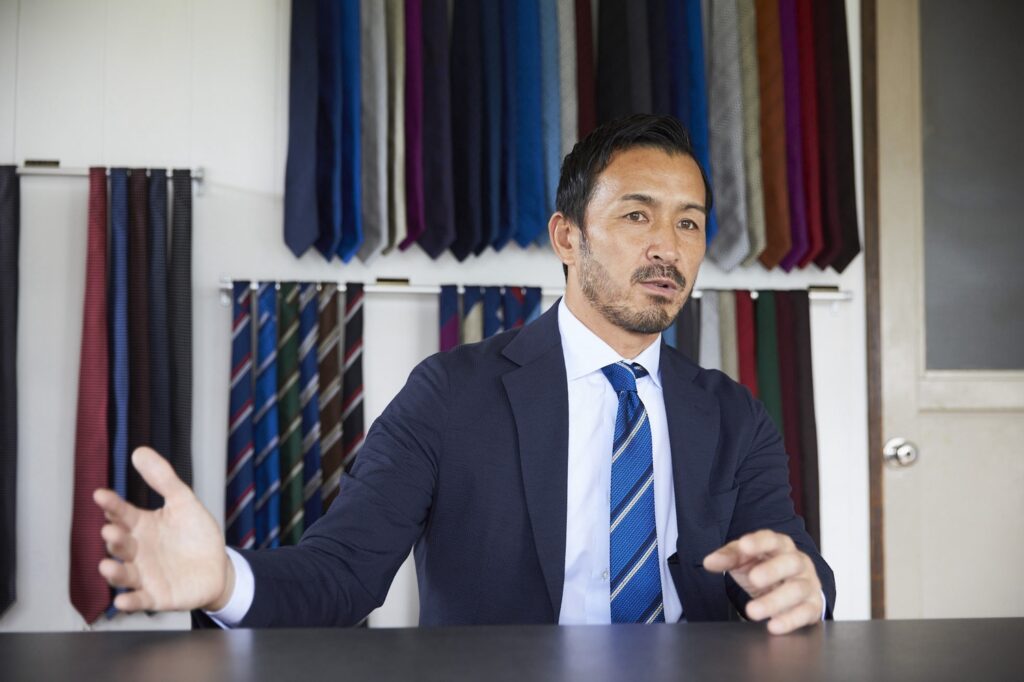
Yasuhiko Kusunoki
Born in Tango, Kyoto, Japan’s largest silk-weaving region. After working in construction in Tokyo, he joined the family business at 30, trained as a weaver for two years, and became its president at 32. Under his direction, kuska fabric has shown at Pitti Immagine Uomo in Florence and is now sold in five countries. In 2024, the brand opened a store in the Imperial Hotel Tokyo. Kusunoki also directs THE TANGO, a web magazine about his home region.
Sato: To begin, could you tell us about kuska fabric?
Kusunoki: We started in 1936 as a weaver of Tango chirimen — the silk crepe used for kimono. For a long time, we wove kimono fabric and sold it to wholesalers in Kyoto.
In 2010, we launched our own brand, KUSKA, where everything is made by hand. Rather than uniform mass production, I wanted to show the world the texture of cloth woven by a craftsman’s hands. We began with ties — to me, a symbol of a man’s sense of style — and focused on them for ten years.
We wanted more people to experience the character of the fabric itself, so we renamed ourselves kuska fabric. Now we also make stoles, bags and more. We handle everything ourselves, from weaving to making the pieces to selling them.
Even where efficiency would tell you to skip a step, we still do it properly. That’s the kind of craftsmanship we value.
Following the Waves Home
Sato: How did you come to take over the family business?
Kusunoki: After dropping out of university in Tokyo, I went into construction. At the time I had no intention of taking over, and my parents didn’t seem to want me to either.
I’d started surfing in Tokyo, and then I learned you could surf in Tango, too. So I went home to surf.
But while I’d been away, the business had come close to shutting down. When I was small, my parents were always at the factory when I got home from school, and I’d go there in the evenings to see them. The place had once been full of life; now it felt completely different.
I felt I was about to lose the place I could always come home to. It wasn’t so much about taking over. It started with a feeling that I had to do something.
Sato: When you first came into weaving, where did you start?
Kusunoki: There were almost no sales, so I had to learn the craft while also coming up with a new business.
Because I’d worked in construction, making things didn’t feel hard. But I’d never sold anything before — that was the difficult part.
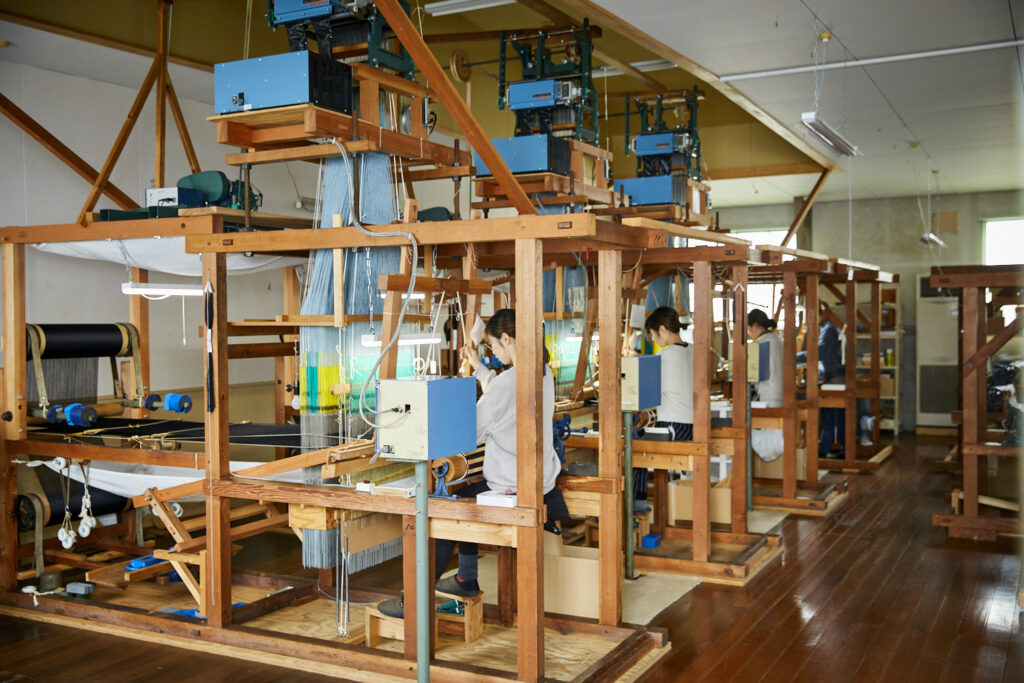
When I became president, I got rid of all the power looms. Machines let you make more, but you end up with the same thing as everyone else. It was precisely because we had almost no sales that I decided to focus on what only we could do.
Only the Hand Loom Remains
Sato: What difference does it make to the fabric, weaving by machine or by hand?
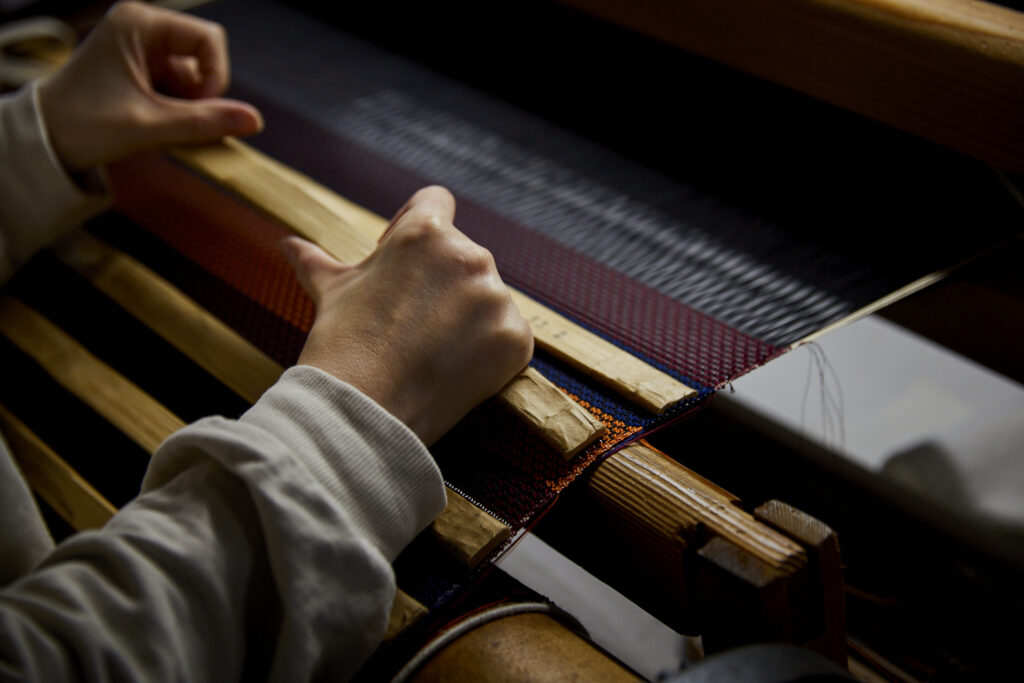
Kusunoki: Machine-woven cloth tends to come out flat. On a hand loom, you weave slowly, letting the silk swell as you go, so the fabric gains depth. When light falls on it, shadows form, and the beauty deepens. That, more than anything, is what defines it.
Tango chirimen has a history of about 300 years. You can’t create that kind of time from scratch. And because this region made the finest fabric for kimono, it always put beauty before function or practicality. That way of creating drew me in, and it’s still the foundation of what we do.
When something is made with human hands and intention, it begins to shine, and it brings people joy and wonder. That is what we call beautiful.
To London, in the Language of Kimono
Sato: What led you to look overseas?
Kusunoki: Ties and stoles are worn all over the world. I also wanted to see whether Japan’s meticulous craftsmanship would hold its own abroad, so around 2017 we began showing at trade fairs overseas.
We do both: trade fairs, and visiting shops unannounced. When we drop in on a shop, we invite them to come and see the collection at the fair.
Sato: How do people abroad respond?
Kusunoki: The response has been strongest in London, where we now have the most stockists. People there appreciate the detail of the handwork and the beauty of the cloth. Rather than presenting ourselves as a traditional craft, we explain that we make beautiful things with Japanese skill and handwork: fabric from Japan’s long kimono tradition, made for the modern suit.
Still, fashion is a market that moves with trends and keeps products turning over. There are people who value history and handwork, but that alone rarely carries a product into wide distribution. We’re in the same market, so we have to keep offering another way of seeing value, every day.
Worth the Journey to Tango

Sato: With all that in mind, what matters most to you in your work at kuska fabric?
Kusunoki: Never compromising on making by hand. And making sure people know about it.
Someday, I’d like us to become a brand people travel all the way to Tango for — even from overseas — just to see the workshop.
A Table for Guests
Sato: And when people do make the journey, where do you welcome them?
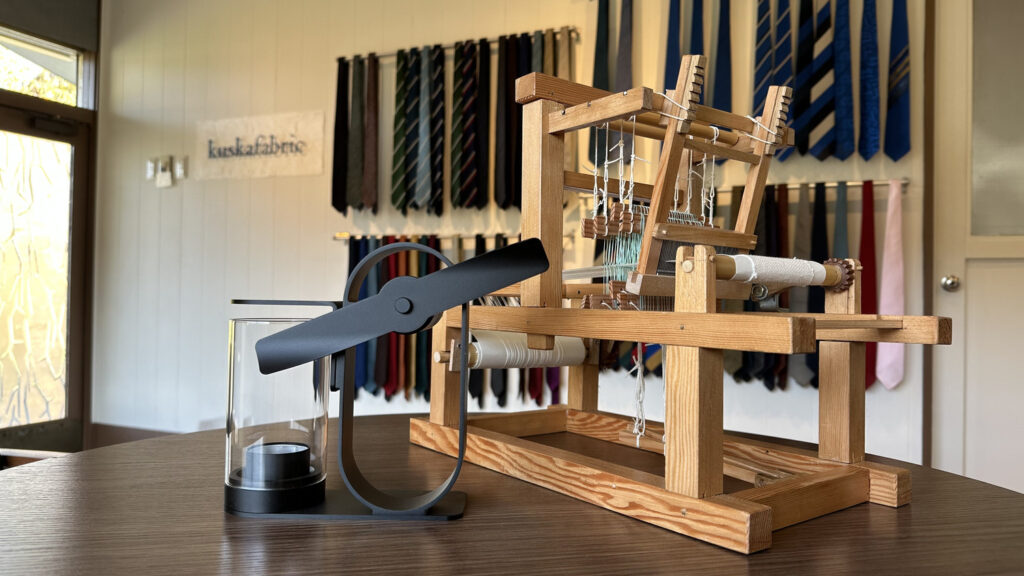
Kusunoki: In the meeting room at our office. On the table, there’s an aroma diffuser from Lei — we keep it there so guests are welcomed into a pleasant space, with a lovely scent.
When guests sit down, they sometimes ask, “What is this?” And from there, the conversation starts to open up.
Product used: Lei non electric aroma diffuser
Visit kuska fabric
The collection can be seen and handled at kuska fabric’s store in the Imperial Hotel Tokyo, where a hand loom is also on display, and at the Tango Factory Shop, beside the workshop where the cloth is woven. In London, it is available at Huntsman on Savile Row. It can also be explored online.
kuska fabric Imperial Hotel Tokyo Branch
Imperial Hotel Tokyo, Basement Arcade, 1-1-1 Uchisaiwaicho, Chiyoda-ku, Tokyo, Japan
kuska fabric Tango Factory Shop
384-1 Iwaya, Yosano-cho, Yosa-gun, Kyoto, Japan
kuska fabric Online Shop
kuska fabric Instagram
Visit Lei
In Tokyo, Lei In Praise of Shadows can be experienced in space — through scent, light, material, and the quiet atmosphere of the store itself. The collection can also be explored online.
Lei In Praise of Shadows Flagship Store
UEHARA TERRACE 1F, 1-30-12 UEHARA, Shibuya-ku, Tokyo, Japan
Related Stories
Lei Journal
What remains unspoken.
What lingers just beyond brightness.
Through the lens of In Praise of Shadows, Lei Journal traces the people, spaces, and practices that take shape not only through what is shown, but through what is held back.
ABOUT Lei
Lei creates time and space to return the senses to 0.
We quietly share the people we meet and the air of each day on Instagram.